
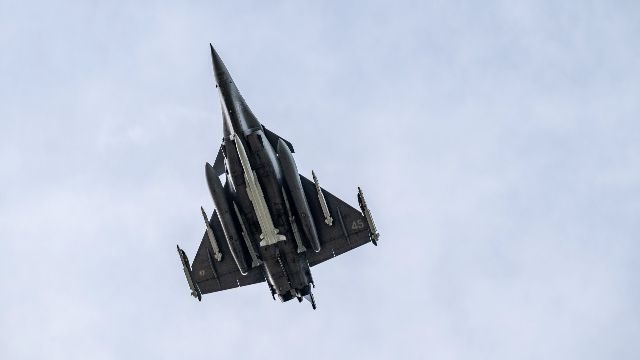
French Navy conducts successful test of upgraded ASMPA-R nuclear-capable missile from Rafale jet. The renovated air-to-ground strategic missile enhances France’s nuclear deterrence capabilities in a planned evaluation exercise.

France’s Ministry of Armed Forces announced a successful evaluation test of the upgraded ASMPA-R missile on November 13, 2025. The French Navy executed the launch from a Rafale Marine fighter jet. Officials confirmed the test involved no military payload. The Directorate General of Armaments tracked the missile’s entire trajectory. This event marks the second overall firing of the ASMPA-R and the first by the Nuclear Naval Air Force, known as FANU.
Minister of Armed Forces Catherine Vautrin highlighted the achievement in a statement. She noted the test as part of Operation DIOMEDE. The operation simulated a real nuclear raid scenario. Vautrin emphasized that this firing confirms the high expertise level of the FANU personnel who managed the execution. The test had been planned for a long time. It aligns with France’s ongoing efforts to modernize its nuclear deterrent under the Military Programming Law for 2024-2030.
The Rafale Marine jet launched the missile during a flight profile typical of carrier-based operations. The French Navy operates these jets from the aircraft carrier Charles de Gaulle. MBDA France developed the ASMPA-R. This company specializes in missile systems and collaborates with European partners. The test demonstrated seamless integration between the Rafale and the missile.
Observers from the Directorate General of Armaments used advanced monitoring tools at sites like Biscarrosse and Hourtin. These tools ensured precise data collection on the missile’s performance. Official images released by the ministry show the Rafale carrying the missile. Some parts of the images appear edited for security reasons, particularly around the air intakes.
This test builds on previous milestones for the ASMPA-R program. The French Air and Space Force introduced the missile in 2023. An earlier evaluation firing occurred in May 2024 during Operation Durandal. That test involved a Rafale B from the Strategic Air Forces. Now, the Navy’s adoption extends the missile’s operational scope to maritime environments.
The ASMPA-R represents an evolution from the original ASMP missile, which entered service in 1986. The ASMPA variant followed in 2009, improving range and warhead capabilities. The renovation project for ASMPA-R started in 2016. It addressed component obsolescence and enhanced performance. Qualification firings took place in December 2021 and March 2022. These steps ensured reliability before full deployment.
The ASMPA-R measures about 5.38 meters in length. It weighs approximately 860 kilograms. A ramjet engine powers the missile. This engine uses liquid hydrocarbon fuel. A solid-propellant booster accelerates it initially after launch. The missile reaches speeds exceeding Mach 3. At high altitudes, it achieves up to Mach 3. At low altitudes, it maintains around Mach 2.
The range extends to about 500 kilometers in typical profiles. Some sources estimate up to 600 kilometers depending on flight path. The missile carries a 300-kiloton TNA thermonuclear warhead in operational use. Inertial navigation guides it to targets. Terrain-following capabilities allow low-altitude flight to evade defenses. These features make it suitable for penetrating advanced air defense systems.
MBDA France leads the production of the ASMPA-R. The company operates facilities across Europe. It employs advanced manufacturing processes for precision components. Supply chains involve specialized suppliers for electronics and propulsion systems. Key partners include Safran for engine elements and Thales for guidance systems. The renovation program incorporated new materials to improve stealth and durability.
Production occurs under strict security protocols. France has delivered around 54 units of the ASMPA variant previously. The ASMPA-R builds on this inventory with upgrades. Industrial processes emphasize reliability testing. Each missile undergoes rigorous quality checks before integration.
The ASMPA-R plays a key role in France’s nuclear doctrine. Known as Force de Frappe, this doctrine emphasizes independent deterrence. The missile serves a pre-strategic function. It acts as a warning shot before full strategic engagement. France maintains a triad of nuclear forces. This includes submarine-launched ballistic missiles, air-launched cruise missiles, and formerly land-based systems.
The Triomphant-class submarines carry M51 missiles. The ASMPA-R complements these in the airborne component. Integration with Rafale jets provides flexibility. The Rafale can operate from land bases or carriers. This dual capability enhances deployment options.
France’s Military Programming Law allocates funds for such modernizations. The 2024-2030 plan invests in nuclear capabilities. Budgets support research and development. However, challenges include rising costs. Official reports note the need for sustained funding amid economic pressures. Geopolitical tensions influence priorities. France faces evolving threats from peer competitors. The test occurs amid discussions on European security. President Emmanuel Macron has offered nuclear sharing concepts. Yet, France retains strict control over its arsenal.
Comparisons with other systems highlight the ASMPA-R’s uniqueness. Russia’s Kh-102 missile offers longer range but different propulsion. The U.S. AGM-86 ALCM uses turbojet engines. The ASMPA-R’s ramjet provides high speed for short-response scenarios. Future developments include the ASN4G missile. This hypersonic variant aims for over 1,000 kilometers range. Planned entry is around 2035. It will equip upgraded Rafale F5 jets. The M51.4 ballistic missile will enhance submarine forces. These projects ensure long-term deterrence.
The test’s success reassures allies. France contributes to NATO’s collective defense. While maintaining nuclear independence, it coordinates with partners. The event drew international attention. Media outlets reported on the images released. Aviation Week noted the first public view of the missile. The War Zone analyzed its implications for naval operations. Experts praise the technological advancements. Hans Kristensen from the Federation of American Scientists tracks such developments. His reports confirm France’s arsenal size at around 290 warheads.
Industrial aspects underscore France’s self-reliance. MBDA’s ecosystem involves thousands of jobs. Supply chains span composites and avionics. Innovations include improved navigation for accuracy. Challenges arise from global disruptions. Semiconductor shortages affect electronics. France mitigates this through domestic production. The Directorate General of Armaments oversees contracts. It ensures compliance with international treaties.
Operationally, the FANU integrates the missile into routines. Training exercises simulate raids. Rafale pilots practice low-level flights. Maintenance crews handle secure storage. Bases like Landivisiau support naval aviation. The Charles de Gaulle carrier enables global projection. This capability deters aggression in various theaters.
Geopolitically, the test signals commitment. Europe faces uncertainties with U.S. policies. France positions itself as a stabilizing force. Macron’s statements on nuclear umbrellas spark debate. Yet, no formal changes occur. The ASMPA-R bolsters credibility without escalation.
In summary, this test advances France’s defense posture. It combines technical prowess with strategic foresight. Observers will monitor future deployments. The ASMPA-R stands as a pillar of modern deterrence.
***
Follow us everywhere and at any time. BulgarianMilitary.com has responsive design and you can open the page from any computer, mobile devices or web browsers. For more up-to-date news, follow our Google News, YouTube, Reddit, LinkedIn, and Twitter pages. Our standards: Manifesto & ethical principles.
How we confirmed this story:
- BulgarianMilitary.com cross-references open-source intelligence, including battlefield maps and geolocated footage, to confirm military movements and resource claims. We analyze official statements, expert insights from defense analysts, and economic data to ensure accuracy.
- Social media posts are scrutinized and validated against primary sources, such as government reports and on-the-ground accounts. Our rigorous process guarantees reliable, fact-based reporting.