
A new apartment in the Mirapolis complex comes with panoramic views of the city. The property
developer boasts easy access to shops and schools, with colourful mock-ups showing families and
manicured gardens. “If you’ve been thinking about owning your own apartment by the sea,” it says,
“now is the best opportunity to realise your dream.” Prices range from about €75,000 to €110,000.
The Mirapolis estate is just one of many “new” residential housing complexes under construction
across Mariupol, the Ukrainian port city subjected to some of the worst horrors of Russia’s
invasion.
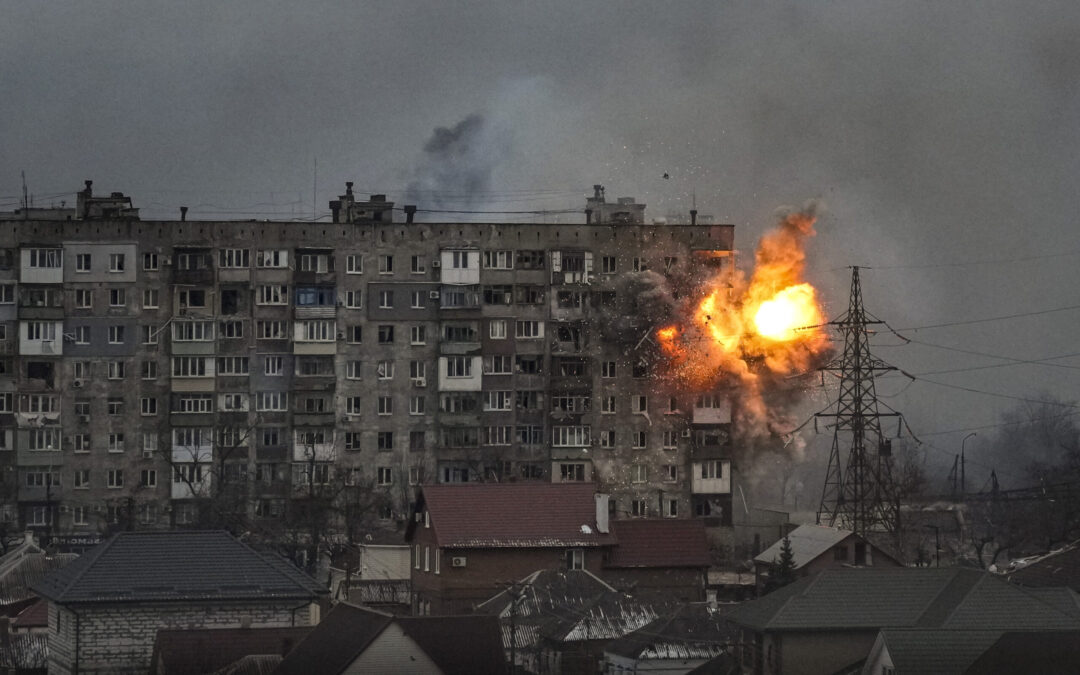
When the apartment blocks that originally stood here were bombed in March 2022, the residents of
Building 127 sheltered in the basement. Children were among the 90 people killed in the attack,
according to Mariupol’s Destruction and Victims
Map, which has documented the devastation across the city. At a nearby burial ground, graves
were marked with crosses made from scrap wood.
Credit: REUTERS
The four high-rises on the western edge of Mariupol were destroyed, and then torn down. Now, they
are being rebuilt.
Credit: REUTERS
Across the road is the new Nevsky residential estate, one of the sites pro-Kremlin media has used to
paint a picture of life returning to normal in Mariupol, which has been under Russian occupation for
more than three years. In a video of Russian president Vladimir Putin meeting residents in the
neighbourhood in 2023, a woman in the background can be heard shouting “This is all a lie!”
The damaged buildings were leveled by 2024.
Credit: Google Earth / Maxar, Google Earth / Airbus
A Bellingcat investigation has identified 23 multi-storey housing complexes — more than 50
buildings with at least 6,000 apartments – being built in the ashes of Mariupol and advertised
for sale, with low interest rate loans, to Russian citizens. Construction of the first buildings
has been completed; new residents have already moved in. Meanwhile, many of the original
Ukrainian owners cannot return home.
Satellite imagery shows the buildings before Russia invaded Ukraine in 2022. By the
summer of 2024, all had been demolished, with some already being rebuilt.
Russia launched its full-scale invasion of Ukraine on Feb. 24, 2022, minutes after
Vladimir Putin announced the start of a “special military operation” on state television.
Credit: Al Jazeera
The strategically important southeastern city of Mariupol was surrounded within days. Homes and
infrastructure were shelled.
Credit: Associated Press
The Russian bombardment cut food, water, power and heat to the besieged city. Internet and phone
lines went down.
Credit: REUTERS/Alexander Ermochenko
Most of Mariupol’s 430,000 residents were forced to flee.
Credit: REUTERS/Alexander Ermochenko
By the time the brutal 86-day siege ended, an estimated 25,000 people had been killed,
including thousands who died when their homes were bombed. Many are buried in mass
graves. The United Nations said
90 percent of Mariupol’s residential buildings were damaged or destroyed.
As part of its post-siege reconstruction of the coastal city, Russia deployed workers to
demolish what was left.
And to rebuild. In the months after Mariupol was razed, the new authorities released a
plan
to “restore” the city and grow its population to 500,000 over the next decade.
It is part of the Russification of Mariupol: streets have been renamed, Ukrainian monuments
removed, and murals painted over. Access to Ukrainian websites has been blocked and Russian
programmes are shown on television. Mariupol and St Petersburg are now “twin cities”.
Russia is painting a picture of a city restored, but many locals still live in perilous
conditions, including some in half-destroyed buildings.
Credit: REUTERS/Sergei Ilnitsky
“A Step into a Bright Future”
The largest of the 23 developments is the Leningrad Quarter, a 10-minute drive from the shore of the
Sea of Azov. The sprawling residential complex, in Mariupol’s north-east, includes at least 11
high-rises along with car parking, recreation areas and children’s playgrounds. Last week, another
phase of the project was released, with four new apartment blocks listed online. “We are building
the future of Russia!” the website for the development says. The apartments are listed for sale with
“preferential
mortgages” at a 2 percent interest rate over 30 years with Russian banks. Mortgage rates in
Russia are, on average, about 20 percent.
Rewind three years. The Leningrad Quarter was a site of death and destruction. People fell from
their windows when the original building at 81 Metallurgist Avenue was shelled and engulfed in
flames, according to posts in a Telegram channel that documented the lives lost here. A
great-grandmother was killed when her apartment in Building 77 burned, her family said. Another
woman died while hiding in the basement of Building 121. “Forgive me, mum, for not saving you,” her
daughter wrote. Near Building 83, someone posted a photo of a 36-year-old woman’s grave, with fresh
flowers and a makeshift plaque. “I don’t know how she died,” they said.
Credit: TASS
Residents who survived the siege of Mariupol, or have since returned to the captured city, face the
challenge of finding somewhere to live. How can they prove ownership when property records are
missing or have been destroyed? To claim their home in the occupied territory – to prevent an “ownerless” property from
being confiscated – they must become Russian citizens and present, in person, with ownership
documents.
Credit: Mariupol’s Destruction and Victims Map
Some residents – including the people who lived in the original Soviet-era buildings at the
Leningrad site – have posted videos to social media, cautiously appealing to Putin and the
Russian-installed authorities in Mariupol to intervene.
“We don’t have the possibility to buy the housing with [a] mortgage, as many of us are
pensioners or have lost practically everything,” one woman said. Another said: “In 2022 we
lost housing, property, and many of us also our loved ones.”
Residents complain about being unable to move back to the sites where they used to live, and
say they were misled about access to compensatory housing. They say many people across the
city are still homeless or forced to rent.
Those who can prove property ownership say the financial compensation being offered is at a
rate far lower than market value. Authorities have said they will compensate residents who
lost their homes in the war, but this is capped at about €12,000 for
a one-person household and €16,000 for a two-person family. The cheapest flats advertised in
the rebuilt apartment blocks start at about €45,000 for a 20m2 studio.
“We are not asking for favours, but for adherence to the law and promises made,” one woman
said. “We ask to be given the housing we were promised, not an offer of [a] mortgage to our
own house or someone’s ‘ownerless’ apartment.”
It’s not only people from the reconstructed high-rises advertised for sale who are impacted. In one
video, a woman can be heard sobbing as she films the hollowed-out shell of a building on the western
edge of Mariupol. This apartment block was demolished but has not been rebuilt.
For Viktoriia Moreva, who lived on the first floor of the building, there’s nothing to go back to.
Moreva was in a friend’s home nearby when airstrikes hit her home in March 2022. She watched it
burn.
“We just couldn’t understand it, why the shelling started with the houses,” she
said. “It was a quiet residential area. There was a school and two kindergartens in
this area. No soldiers were in the houses. Only civilians.”
“Flagrant Violations of International
Law”
Professor Balakrishnan Rajagopal, the UN’s Special Rapporteur on the right to adequate housing, said
Russia’s attacks on homes and residential areas in Mariupol were “grave war crimes and crimes
against humanity”.
He told Bellingcat that the scale and intensity of destruction, mass displacement of residents and
deaths of civilians constituted “one of the most flagrant violations of international law” and were
“comparable to some of the worst examples from World War II”.
“Mass destruction of homes during conflict as in Mariupol are acts of ‘domicide’, as I proposed to the UN General Assembly
in 2022, and may constitute war crimes, crimes against humanity or even genocide, depending on
facts,” he said.
Professor Rajagopal said the housing policy measures implemented by Russia were contrary to the
basic rules of international law, such as the prohibition against taking private property during
occupation under the laws of war, including the Hague regulations.
“What appears to be happening is in fact an annexation of Ukrainian territory, through occupation
and creation of new property rights which excludes the former owners,” he said. “Declaring a
property ‘ownerless’ or ‘abandoned’ in order to annex it is an old colonial legal trick that settler
colonial states have used for hundreds of years when such property, usually belonging to native
populations, was declared ‘terra nullius’ (no person’s land) in order to acquire it, but is
considered to be completely contrary to modern international law.”
“What Russia is attempting is to go back to medieval practices and discredited norms such as ‘terra
nullius’ that Russia itself, as part of the Soviet Union, actively opposed for decades.”
A 2023 analysis by the Kyiv School of Economics estimated the damage to Ukraine’s housing stock to
be almost $56 billion. Mariupol was one of the worst-affected cities: Ukrainian authorities said
more than 11,000 homes were destroyed and tens of thousands more were damaged. Half of the 2,600
multi-storey residential buildings were reduced to rubble.
Credit: REUTERS
Over a large block that was decimated in central Mariupol, seven separate residential complexes are
nearing completion. Among them are four gemstone-named developments ranging from nine to 15 storeys.
Three apartment blocks in the centre of the “resort town” – the Residence I, Residence II, and
Residence III – are due to be completed by the end of the year.
Like the other estates analysed by Bellingcat, these apartments are listed on Russian real estate
websites with low-interest loans.
The advertisements target families with children: “Everything is close by: the sea, a park, schools,
medical facilities and a church,” says one for the new Residence III. They don’t show what was here
before.
The tree-lined street where Residence III now stands became a graveyard during the siege.
Credit: REUTERS / Alexander Ermochenko
A short walk away is Hospital No. 3, the children’s and maternity hospital bombed by Russian forces
on March 9, 2022. “Everything was destroyed in one second,” said Elena Karas, a nurse who was caring
for 13 premature babies on the third floor. “I didn’t ever think they could bomb our hospital. Not a
hospital. You would think it’s a safe place,” she
told The New York Times.
Ukrainian authorities said three people were killed and more than a dozen others were injured in the
attack, which President Volodymyr Zelensky said was evidence of genocide.
Iryna Kalinina, the wounded pregnant woman in this photograph, and her unborn baby – named Miron,
meaning “peace” – both died.
Credit: Associated Press / Evgeniy Maloletka
Across the road from the hospital, construction workers are building the Horizon complex, two
“comfort class” high-rises due to be finished by 2026.
A block behind the site is the Cypress complex. The residential building that originally stood here
was bombed and later torn down. Advertisements for Cypress – “a new destination for those who value
prestige, comfort, and reliability” – tout the 15-storey building’s proximity to Hospital No. 3.
On March 16, 2022, a Russian airstrike hit
Mariupol’s drama theatre.
The grand Soviet-era building had become the city’s main bomb shelter, with hundreds of civilians
seeking refuge inside. Outside, the word “CHILDREN” had been spelled out on the ground in giant
Cyrillic letters. As many as 600 people reportedly
died in the attack.
Credit: Google Earth / Airbus
Less than 500m from the theatre is the original site of the House with the Clock, a historic
landmark in the city’s centre. Noted for its clock tower, the 1950’s building served as a meeting
place for the city’s residents.
In the months before Russia’s invasion, its facade had been restored and a new clock installed.
Credit: House with the Clock / Google Maps
The building was shelled during the siege and demolished after Mariupol fell.
Credit: Mariupol’s Destruction and Victims Map
A new multi-storey complex with studio, one- and two-bedroom apartments was built on the site in
late 2024. “The House with the Clock was a recognisable symbol of Mariupol, but was damaged during
the war,” the property developer’s website says.
As is the case with most new complexes analysed by Bellingcat, its original address was changed
under occupation – a tactic Mariupol’s residents say further complicates their claim to housing. The
House with the Clock was on Myru Avenue – “Avenue of Peace”. The road has since been renamed Lenin
Avenue, after the former Soviet leader.
Farther east is the Azovstal Iron and Steel Works plant, where Mariupol’s last defenders surrendered on May 20, 2022.
Credit: Cover Media via REUTERS
Beyond the Azovstal steelworks are four new residential developments: the Olympic, Left Bank,
Zhukova and Designer’s House Mari, a seven-storey “business-class” complex “inspired by the sandy
coast”.
The bombed-out building seen in this footage is where Designer’s House Mari is being built.
Credit: Defense of Ukraine
Polished advertisements for the new building show it will feature landscaped courtyards and a
24-hour concierge service. Prices for a two-bedroom apartment are listed for about €130,000.
Ukrainian journalist Mstyslav Chernov and his Associated Press colleagues were trapped in Mariupol
during the first weeks of the siege.
The last international journalists to remain in the city, they captured
some of the most defining – and haunting – images of the war.
The crew reported from across the charred city, including in Mariupol’s north-west, near the new
655-apartment Mirapolis complex. In this area, four new complexes are also under construction.
“This is where your story begins,” a website for the Azure Coasts development says. Among the people
killed here in March 2022 was an elderly man. “He lies there under the rubble,” his granddaughter
posted on Telegram.
An apartment building on Kuprina Street promises its new residents “comfort, security and
affordability”. A video filmed nearby after the original buildings were bombed shows unburied bodies
on the grass, carefully wrapped in sheets.
Credit: Mariupol’s Destruction and Victims Map
Maple Alley, a complex with 10 apartment blocks, is featured in a Russian YouTube video with the
caption: “Dreaming of an apartment by the sea with a preferential mortgage?” It is being built where
a mother and her son were buried with their neighbours during the siege.
Credit: Mariupol’s Destruction and Victims Map
This high-rise, advertised as having children’s playgrounds and being close to a kindergarten, is on
Troyiczka Street, which has been renamed to commemorate the USSR.
Credit: Mariupol’s Destruction and Victims Map